Programming
MylibSQLAdmin v1.6.3: What 488 Commits and a Blank Page Taught One Dev
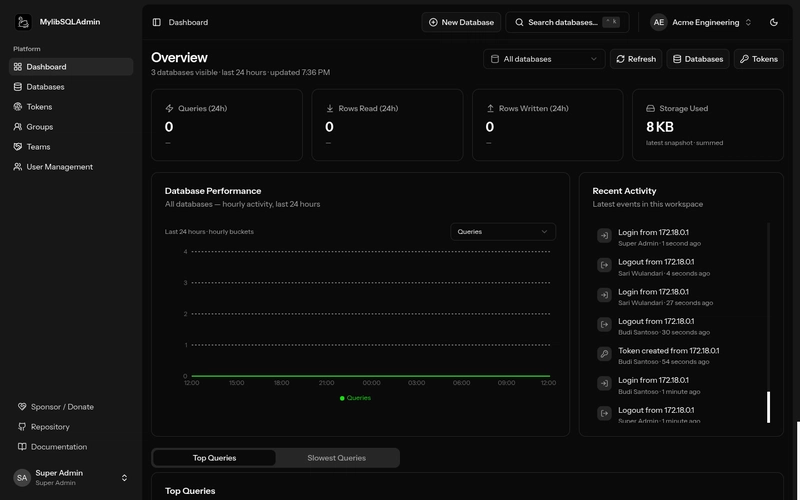
MylibSQLAdmin, a self-hosted management platform for libSQL, has reached version 1.6.3 after 488 commits. The solo developer behind it published a research journal of the journey, and it is refreshingly honest: broken releases, a blank page that slipped into multiple versions, and six security problems that had been hiding for a long time. The platform includes a web GUI and a PHP CLI called libsql3.
From a simple question to dormancy
The first commit landed on March 5, 2025. The motivation was practical: the developer ran several libSQL-server (sqld) instances and struggled to remember which endpoint did what, where the tokens lived, and which database belonged to which team. The goal was an experience like Turso's cloud console, but running on their own server with their own keys.
The result was a Laravel app wrapped around the sqld admin API, with databases, tokens, groups, teams, users, and activity logs. Versions 1.3.x and 1.4.x shipped through June 2025. After that the project was set aside because a paid project needed attention.
Between July 27, 2025 and November 14, 2026 there are only thirty commits, most of them in the first few weeks. The repository stayed public, with a working release and a quiet issue tracker. During that time the developer stayed active in the PHP ecosystem for Turso, working on the extension, drivers, and installers, and picked up lessons this project would later need.
A stack upgrade exposes six security problems
On November 14, 2026 the developer returned with one intention: upgrade the stack and see what breaks. The target was Laravel 13, PHP ^8.4, Inertia 3, React 19, Vite 8, and Tailwind 4. The upgrade itself was easy. What it exposed was not: on the same day, six security-related problems turned up and were fixed.
- Closing the open data plane (SEC-01).
- Hashing database tokens at rest (SEC-02).
- Binding CLI authorization to Sanctum identity instead of headers.
- Enforcing authorization on token mint and delete.
- No longer baking default super-admin credentials into the image.
- Scoping authorization policies per tenant (SEC-06).
Before this, the data plane was open, tokens were stored as plaintext, and tenant isolation was more suggestion than rule. None of these fixes was a new feature.
The next day, November 15, came the beta storm. v1.5.0-beta.1 shipped at 01:21 and was broken right away: the seeder didn't create the super-admin, so fresh installs had no account to log in with. Beta.2 fixed that but introduced a 500 error on token creation. Beta.3 fixed both. Then v1.5.0 through v1.5.4 went out the same day, five releases in one day, which the developer admits points to a release gate that was too thin.
Notably, the bad releases were not hidden. On the GitHub releases page, beta.1 and beta.2 carry DO NOT DEPLOY markers, and later so did the entire v1.5.0 to v1.5.5 range.
The blank page that slipped through six releases
On November 16 came the biggest finding: every release from v1.5.0 to v1.5.5 rendered a blank white page. React never mounted. There was no 500 error or exception in the logs, just a 200 response with nothing inside. There were two root causes, both from the Laravel 13 and Inertia v3 upgrade:
- The file resources/js/app.tsx lost its resolve prop because the resolvePageComponent import was deleted, leaving the client with nothing to mount.
- Inertia v3 delivers page data through a JSON script block. Installations with a stale compiled Blade cache from v2 still rendered the old div format, so getInitialPageFromDOM() returned null and the client crashed with Cannot read properties of null (reading 'component').
The fix shipped in v1.5.6. The lesson is now written into the release process in capital letters: curl smoke checks only verify HTTP 200 and cannot catch a client mount failure, so UI releases require a browser check. Since that day the fresh-install smoke gate has been a mandatory instrument. It covers boot logs, migrations, seeded credentials, login, creating a group and a database, verifying the namespace on disk, token reveal, creating and archiving a member, and zero console errors, all on the exact images about to ship.
Once the blank page was fixed, the developer clicked through every page of their own app and wrote down everything that misled them. The total came to roughly forty to fifty small dishonesties: metrics that looked heroic while the database sat idle, a token reveal feature that was documented but never existed, a member count that was always three, an interactive tooltip that said nothing, destructive actions confirmed by a five-second toast instead of a dialog, and a user table with no Last Active column, so every account looked equally alive.
If you run libSQL or sqld yourself, this journal is a reminder that a major framework upgrade can pass automated checks and still produce an empty page. If you ship web apps, a check in a real browser can't be replaced by a 200 status.
Source: dev.to
Category
Programming
Share