Security
Docker AI Governance Explained: Securing AI Agents in the Enterprise
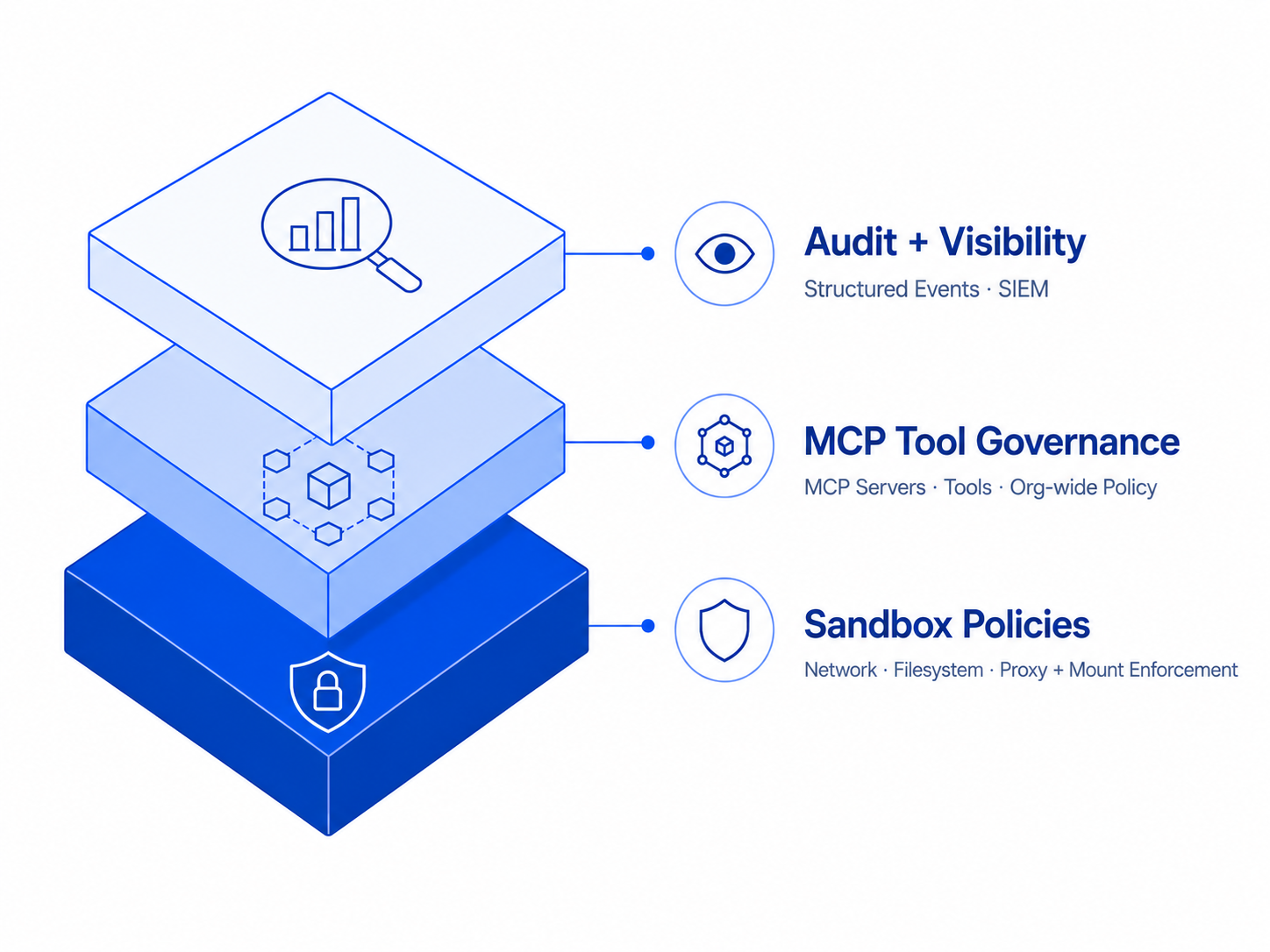
Docker has introduced a security approach for AI agents called Docker AI Governance. The idea is that companies can give agents freedom to work, but the limits are enforced by infrastructure rather than by model behavior. Docker calls this layer a trust layer: the infrastructure sitting between what an agent wants to do and what the organization actually allows. It has three parts: Sandbox Policies, MCP Tool Governance, and Audit + Visibility.
The problem starts once an agent can do more than answer a prompt. An agent can execute code, access files, connect to services, and call external tools. A model decision is not automatically an authorized action, and that distinction matters the moment model output turns into action in a real system.
For a CISO, this creates a trust gap. Approving AI agents means answering more than whether the model is capable: what access the agent has, where those boundaries are enforced, and what evidence is available afterward. Docker boils this down to three questions: where can the agent operate, what can it do, and can we see what happened. On the software supply-chain side, Docker Hardened Images address a different question: what software artifacts do these agent workflows build and use?
Sandbox Policies: Where Can the Agent Operate?
An agent needs enough access to get real work done. A coding agent, for example, may need to install packages, build containers, edit project files, or connect to external services. The challenge is deciding those limits before the agent starts acting.
Docker Sandboxes give each agent an isolated microVM environment. It's a lightweight virtual machine with its own Docker Engine, filesystem, and network. Docker AI Governance adds policy on top so security teams can control network and filesystem access centrally.
- Network policies can allow or block specific domains, IP ranges, and ports.
- Filesystem policies control which host paths can be mounted into a sandbox, and whether that access is read-only or read-write.
These controls are enforced at the network proxy and filesystem mount layers, so they don't depend on the agent following instructions. The same boundaries can follow developers across all their sandboxes without being configured separately on each machine, and an agent can't expand them on its own. Developers can also check the effective boundary before the agent runs, for instance with the sbx policy check network command followed by a domain name. The result (Allowed or Denied) comes from the active policy.
MCP Tool Governance: What Can the Agent Do?
MCP (Model Context Protocol) gives agents a common way to connect to external tools, services, and capabilities. That also expands what an agent can act on. For enterprise use, a tool being available shouldn't automatically mean every agent can use it.
Docker AI Governance puts policy around MCP activity handled through Docker's MCP Gateway. Administrators can control which MCP servers may be registered and what agents can do through them, from tool calls, resources, and prompts to approval requirements. These organization policies are written in Cedar, a policy language for expressing authorization rules. When MCP policy enforcement is active, governed requests are denied unless a matching policy permits them. For example, one policy can permit read-only tool calls for a specific registered MCP server.
There's a caveat with that example: the read-only status comes from the MCP tool's annotations. Those annotations are supplied by the server and are advisory, so the example relies on metadata from that server. Policies can also require confirmation for specific tool calls when an action needs an extra checkpoint.
One boundary is worth noting: MCP policies apply only to activity handled by Docker's MCP Gateway. If an agent connects directly to a remote MCP server from inside a sandbox, that connection falls under the sandbox's network policy.
Audit + Visibility: Can We See What Happened?
Setting a policy is only half the job. Security teams also need to know when a policy was applied, what action triggered it, and whether the action was allowed or denied. Docker AI Governance records sandbox policy decisions and sandbox session events as structured audit records.
If you're starting to use coding agents in your team or company, Docker's three questions make a practical framework: where the agent works, which tools it can use, and what trail it leaves behind. What stands out is that the boundaries live in the environment and the policies, not in trust in the model's behavior.
Source: docker.com
Category
Security
Share