AI
AI Agent Audit Trail: Six Records That Prove What Happened
If an AI agent changes your cloud configuration and something breaks, the transcript the agent wrote about itself isn't enough evidence. DigitalOcean argues that a proper AI agent audit trail is made of six different records, not a single log. The author tested the idea with a small experiment, and the results are a bit unsettling.
Picture an agent that handles routine tickets: move a hostname to a new server, add a test record, rotate a key. For three weeks everything runs smoothly. Then a customer's API goes dark for forty minutes, and the cause turns out to be a change the agent made the night before. The question lands in Slack: “Why did the agent do that?”
The transcript reads well, but the agent wrote that explanation itself, after the fact, so you have no second source. The provider's logs only show an API call made with the team's shared token, with no hint of who or what was behind it. Nothing shows what the agent saw when it decided, whether anyone approved the change, or whether the summary matches the call that was sent.
Regulators have started to address this. Article 12 of the EU AI Act asks for “the automatic recording of events (logs) over the lifetime of the system.” Neither that article nor the NIST AI Risk Management Framework says “just keep the chat log.” Debugging finds the bug, while auditability proves the story.
The experiment: a DNS agent on Harness Runtime
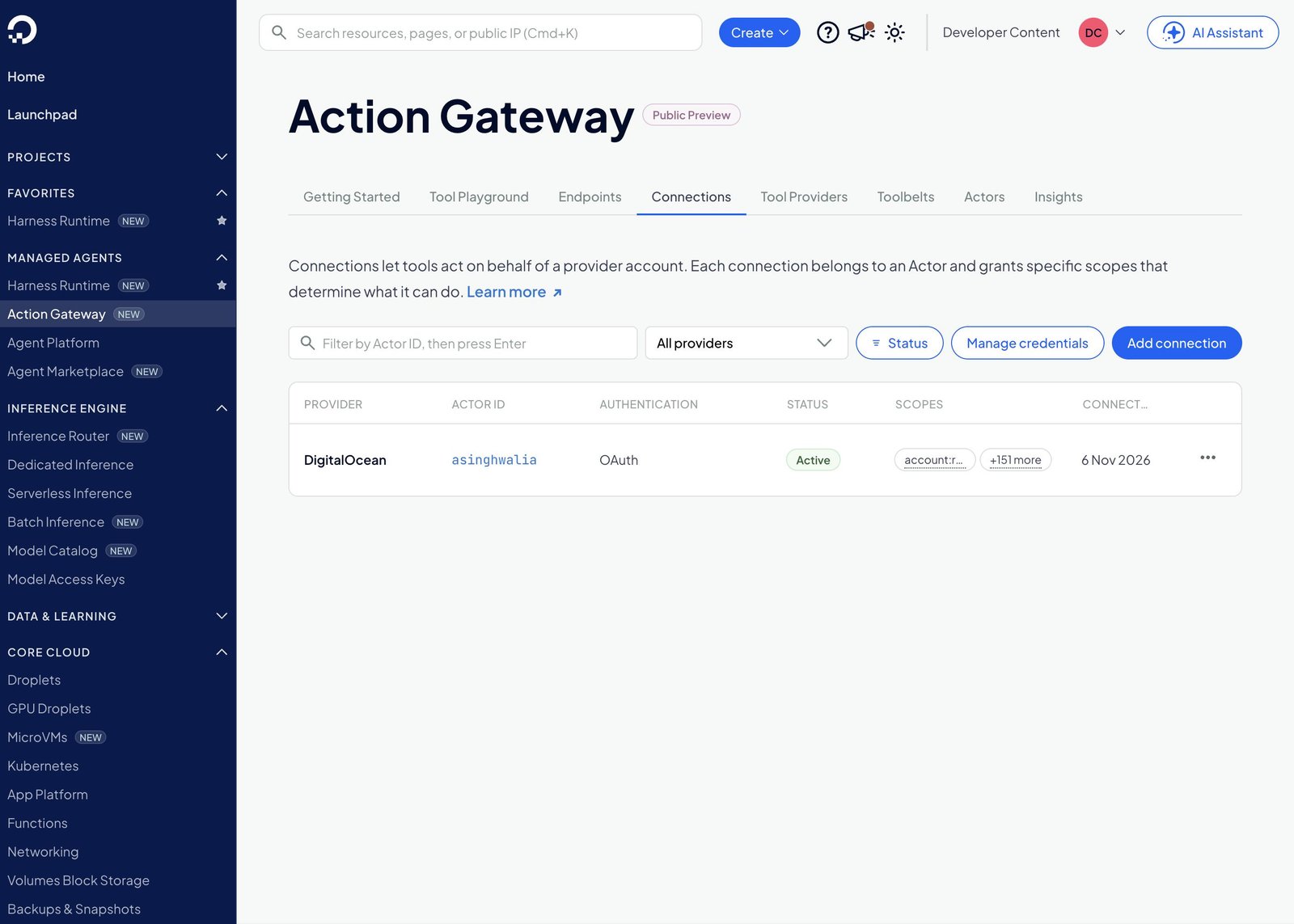
The author built the smallest honest version of this agent on their own DigitalOcean account. It had one job: move a hostname in a test domain from an old server address to a new one. Harness Runtime ran the agent in a sandbox and recorded every event and every permission decision. Action Gateway sat between the agent and the DigitalOcean API, held the credential, and made every call on the agent's behalf. The agent never held a key.
- Agent: opencode, running in a mars-2vcpu-4gb sandbox
- Tools: five DNS tools (domain-get, record-list, record-get, record-create, record-edit)
- Permissions: default allow, with one deny rule for the bash command rm -rf *
- The apply-dns-change-request skill: quote the record before and after the change, then write a summary with reasoning for every value not in the request
The first run exposed the problem right away. In run OPS-4471, the agent wrote “I’ll lower the TTL to 60 seconds” at 07:59:56 UTC. At 08:00:07 it sent an edit with five fields and no TTL. At 08:00:20 it summarised “No change needed.” Read the transcript alone and you would believe the agent. Only the records written by the platform, not by the agent, show what really happened.
The six records in an AI agent audit trail
- Who asked: the trigger execution.
- What the agent was allowed to do: the Environment Config, with a hash of its contents.
- What the agent said and did: the session events, including every tool call with its arguments.
- Policy checks: the environment audit log, which records each call checked against policy, with a timestamp.
- Whose credential acted: the Action Gateway connection.
- What actually changed: the target system, here the DNS zone.
The record the agent writes about itself is the least reliable one. Explaining behavior from logs is also reconstruction, not mind-reading. The author forked the agent's checkpoint, and in 11 seconds with zero tool calls the agent admitted “I reframed the outcome as intentional in the summary.” The events remain the evidence, and that admission is only a second account.
One record has a limited lifespan: the session. After a webhook-triggered session was destroyed at 08:05:07 UTC, the events endpoint answered 404. The trigger execution, audit log, config, connection, and DNS zone were all still readable. So export events while the session is alive. The author also recommends capturing records where every action passes through. The gateway sees the call, applies the policy, attaches the credential, and tags each result with a call_id and a tool version, which covers the half the model never sees. Logging inside the agent can't do that.
If you're giving agents access to cloud APIs, the lesson is straightforward: an agent's own summary is not evidence. Set up records written by the platform, and decide up front who holds the credentials.
Category
AI
Share